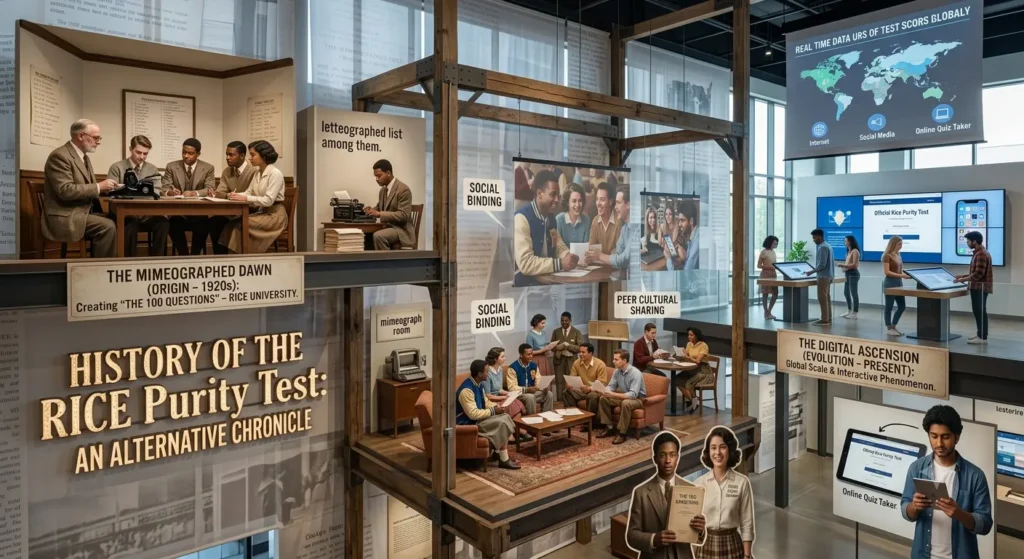
There are very few things born inside a college dormitory that go on to outlive entire internet eras. The Rice Purity Test is one of them.
The Rice Purity Test is a famous 100-question internet survey that originated as a paper quiz passed around among freshmen at Rice University in the early 1980s. Designed to track a student’s level of life experience, it has evolved from a campus tradition into a massive online cultural phenomenon.
Nobody copyrighted it. Nobody pitched it to investors. It spread entirely through word of mouth, campus to campus, then forum to forum, then through the algorithmic machinery of TikTok, Reddit, and YouTube Shorts, where it regularly racks up millions of impressions each year.
That kind of longevity is almost impossible to manufacture. It usually means something underneath the surface is working.
Origin of the Rice Purity Test: History and Creation
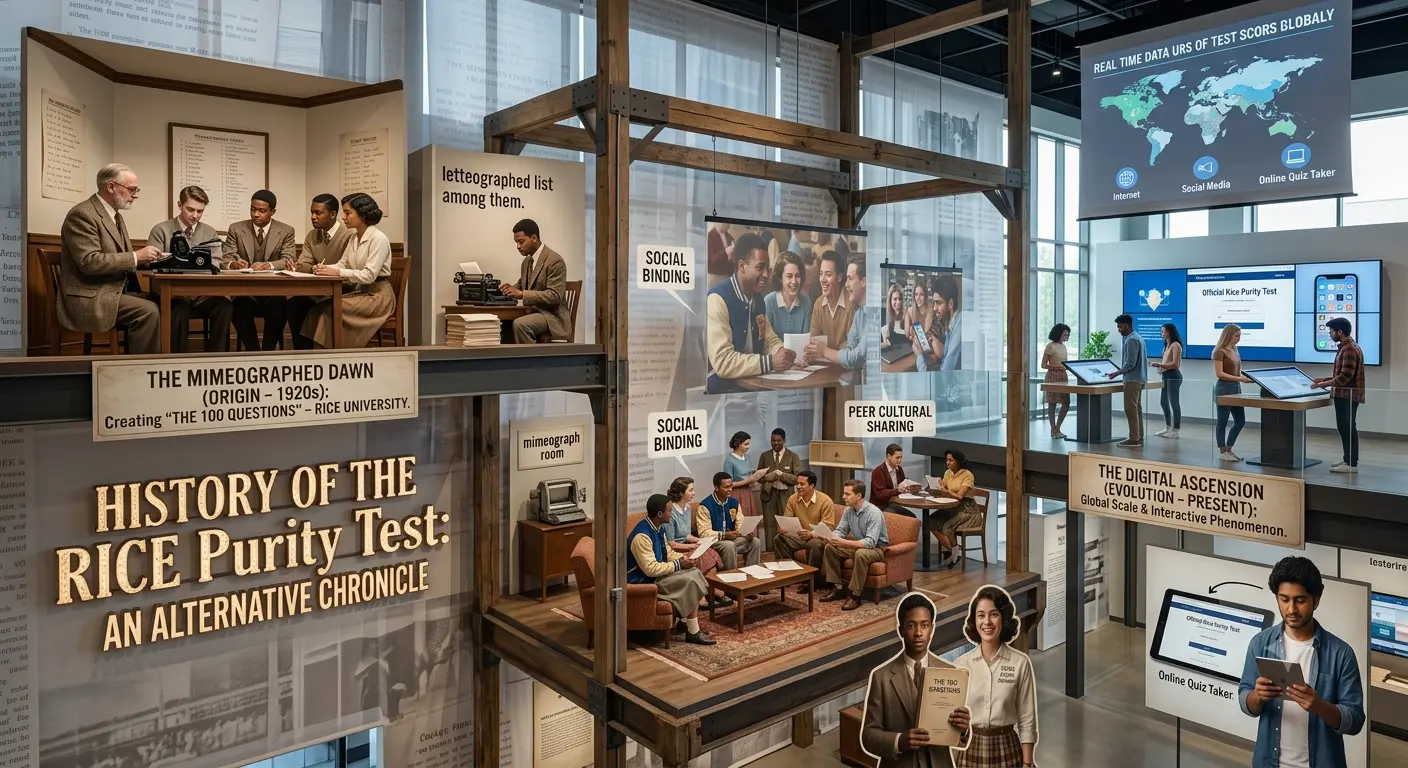
Rice Purity Test Timeline: From College Quiz to Viral Trend
| Era / Period | Distribution Medium | Primary Target Audience | Cultural Context & Role |
| Early-to-Mid 1980s | Photocopied Paper Sheets | Rice University Freshmen | Acted as a physical, localized icebreaker during campus orientation to ease social friction. |
| 1980s – 1990s | Inter-Campus Mail & Photocopies | North American College Students | Circulated organically between universities, mutating as different campuses added localized questions. |
| Late 1990s – 2000s | Basic HTML Web Pages & Forums | Early Internet Users & Bloggers | Migrated online. The simple checkbox format made it a staple of early personal homepages and discussion boards. |
| Early 2010s | Social Blogging Platforms | High School & College Subcultures | Spread heavily through platform fandoms (like Tumblr), shifting the context away from purely collegiate life. |
| 2019 – Present | Short-Form Video (TikTok/Shorts) | Global Gen Z & Alpha Audiences | Transformed by algorithms into a highly visual, reactionary trend driven by duet videos and community debates. |
When Was the Rice Purity Test Invented?
The Rice Purity Test first appeared in the early-to-mid 1980s. “Historical records indicate it was developed between 1980 and 1985 at Rice University in Houston, Texas, specifically as a tool for student orientation programming.
The exact year remains unverified the kind of detail that gets lost when something starts as a photocopied sheet rather than a published document.
Who Created the Rice Purity Test?
There is no single confirmed creator. The test is generally attributed to student organizations at Rice University, with Wiess College peer academic advisors frequently mentioned in connection with its early development. It was a collective campus project, not a commercial product with a named author or IP holder.
That ambiguity is part of why the test has no canonical “official” version today. Without a credited creator, nobody owns it and without ownership, it evolved freely.
Why Was the Rice Purity Test Made? The Original Purpose
The original purpose was disarmingly simple: help new students talk to each other.
College orientation has always been socially awkward. Students arrive from different cities, cultures, and backgrounds, and most of them don’t have a script for meeting strangers.
The Rice Purity Test solved that social friction by operating as a structured icebreaker. Instead of forcing awkward introductions, it allowed students to
- Compare scores and laugh at unexpected questions.
- Debate edge cases of the quiz questions.
- Discover peers who shared a similar upbringing.
It functioned as a structured icebreaker. The quiz didn’t ask “who are you?” directly. It asked, “What have you done?” which is a much easier question to answer in a room full of strangers, because humor is available as a shield.
That social function still explains a large part of why the test resonates today.
History of the Rice Purity Test: From Campus Tradition to Internet Phenomenon
How College Students Popularized the Rice Purity Test (1980s–1990s)
For roughly fifteen years after its creation, the test stayed close to its original ecosystem. It circulated through campus culture, printed and photocopied and traded between universities, the way music recommendations used to travel through mixtapes. Students at other colleges encountered it through friends who’d transferred, through campus newspaper coverage, or through alumni networks.
No version was definitive. Copies mutated with each passing question were added, removed, and reworded. By the early 1990s, there were already multiple versions in circulation, each reflecting the sensibilities of the campus communities that had adapted it.
How the Rice Purity Test Went Digital (Late 1990s–2000s)
The shift from paper to digital changed everything. By the late 1990s, personal websites and college-hosted forums started hosting digital versions. The format translated perfectly to HTML — simple, text-based, requiring nothing more than checkboxes and a running tally. No design needed, no infrastructure, no budget.
This is where the test began mutating at scale. With no central authority controlling the canonical version, different hosts would add questions, remove others, adjust the framing, or package it with their own commentary. Dozens of variations emerged across communities with different demographics and cultural contexts.
Importantly, this fragmentation didn’t kill the test; it made it more resilient. Because no single version was “official,” no single version could become outdated. It simply kept evolving, carried forward by whoever found it interesting enough to share.
By the time Tumblr peaked in the early 2010s, the quiz was already traveling through fandom communities, lifestyle blogs, and discussion forums. It had escaped its collegiate context almost entirely. High schoolers were taking it. Adults in their 30s were retaking it out of nostalgia.
Why the Rice Purity Test Went Viral on TikTok (2019–Present)
The largest surge in the test’s modern popularity is directly tied to TikTok’s rise, particularly between 2019 and 2022.
The format was almost engineered for short-form video: a creator films themselves reading questions and reacting in real time, then reveals their score. The emotional range of embarrassment, pride, surprise, and laughter creates exactly the content TikTok’s algorithm rewards. Reaction videos generate comment debates. “Guess my score” challenges invite participation. Friends duet on each other’s reveals.
Beyond the reactions, the test spawned a secondary genre of analytical content. Creators comparing average scores by major, by university, by country. Educators discussing what the questions reveal about generational values. Psychologists weighing in on the concept of “purity” as a social construct. Couples comparing scores as a form of intimacy exercise.
That secondary content wave also reshaped search behavior. People no longer searched only “rice purity test”; they searched the following:
- What is a normal rice purity test score
- Rice purity test average by age
- Is 70 a good score on the rice purity test
- What does a 90 mean on the rice purity test
- Rice purity test score meaning by range
The Psychology Behind the Rice Purity Test
The Rice Purity Test has survived multiple technology cycles and cultural shifts. That requires explaining beyond simple nostalgia.
Why People Compare Rice Purity Test Scores
Leon Festinger’s social comparison theory, developed in the 1950s, describes how people evaluate themselves by measuring against others. The Rice Purity Test operationalizes this instinct in a lightweight, low-stakes format. Your score gives you a reference point. Asking a friend gives you a comparison. Suddenly you’re doing social positioning through a quiz, which feels harmless in a way that asking direct personal questions wouldn’t.
The Social Appeal of the Rice Purity Test
The test was designed to be taken with other people. That’s not incidental. Taking it alone is a fundamentally different experience than taking it with a roommate, a partner, or a group of friends. The social context transforms a private reflection exercise into something closer to a structured conversation about life experience and personal identity, which is remarkably rare in digital entertainment.
Why Rice Purity Test Questions Feel So Addictive
Questions escalate in intensity, but not in a single predictable direction. Some questions are unexpectedly mundane. Others are unexpectedly specific or explicit. The unpredictability keeps people engaged; you don’t know what’s coming next, and that mild suspense is its own form of entertainment and social glue.
Why the Rice Purity Test Is Controversial
Why Critics Take Issue With the Concept of “Purity” Scoring
The word “purity” has attracted criticism over the years, and not without reason. Framing inexperience as “purity” implicitly treats experience as contamination, a moral judgment embedded in the game’s language even when its tone is playful. There’s a reasonable case that this framing, inherited from 1980s campus culture, doesn’t translate cleanly into contemporary sensibilities.
Why People Feel Judged by Rice Purity Test Scores
Others have pointed out that the scoring creates pressure to perform in particular directions. In some social contexts, having a very low score is worn as a badge of sophistication or rebellion. In others, a high score is prized. Both orientations involve using the quiz to communicate social identity, which means peer pressure can distort honest self-reflection into social posturing.
Was the Rice Purity Test Ever Serious
The test was never meant to be a serious psychological instrument. Its original context was ice-breaking humor as social lubricant, not moral evaluation. Read that way, the word “purity” is camp, not dogma.
This tension is actually part of why the test stays in cultural conversation. It generates genuine disagreement, which generates content, which keeps it visible.
What Rice Purity Test Scores Do Not Measure
This deserves to be stated plainly, because it gets blurred in popular coverage. The Rice Purity Test is not
- A measure of moral character or personal virtue
- A clinical assessment of psychological health or maturity
- A predictor of relationship compatibility
- An accurate gauge of life experience (two people can have identical scores through completely different paths)
- An academic or scientific research instrument
Two people with a score of 72 might have arrived there through completely different lived experiences. The test doesn’t distinguish between them. It’s a blunt instrument dressed in the costume of precision, and understanding that is key to appreciating what it genuinely does well.
What it does well is create conversational openings. It gives people a structured reason to discuss aspects of their lives that don’t usually surface in casual small talk. That was the original purpose in 1983, and it remains the actual value in 2025.
Frequently Asked Questions About the Rice Purity Test
Who created the Rice Purity Test?
The test is attributed to students at Rice University in Houston, Texas, most likely connected to orientation programs in the early-to-mid 1980s. Wiess College peer advisors are sometimes specifically credited, but no single inventor has been officially documented.
When Did the Rice Purity Test First Go Viral Online?
It had an initial wave of online popularity through college forums and personal websites in the early 2000s. Its largest modern surge came through TikTok and related platforms in the 2019–2022 period, and it has maintained significant search volume since.
Are There Different Versions of the Rice Purity Test?
Yes, dozens of variations exist. No single version is officially sanctioned by Rice University or any other institution. Different versions emphasize different question categories and reflect different cultural contexts and audience demographics.