Most people finish the Rice Purity Test expecting to feel something vindicated, surprised, maybe a little judged. What they get instead is a number sitting on a screen with no real explanation attached.
That number has been shared in group chats, debated on Reddit, and quietly Googled by millions of people who want to know: am I normal? The answer is almost always yes but the reasoning behind that matters more than the reassurance. This guide breaks down every score range, the age context that most articles completely ignore, and the specific questions people are actually searching for.
How the Rice Purity Test Scoring Works
The mechanics are simple. You start at 100. Every “yes” answer subtracts one point. Say yes to 30 questions, you score 70. Say yes to 15, you score 85. No question is weighted more than another holding hands and a felony conviction are each worth exactly one point off your total.
The test originated at Rice University in the 1980s as an orientation week icebreaker. Students answered questions about their life experiences relationships, substances, sexual activity, legal run-ins mostly to spark conversation with new classmates. It eventually migrated online and hasn’t stopped spreading since.
The Rice Thresher (Rice University’s student newspaper) published the most cited dataset: 61.46 average across 124,952 verified takers. Current self-reported aggregates from widely-cited online platforms put the figure between 63 and 68, varying by sample and year.
Rice Purity Score Meaning — Full Range Breakdown
| Score | Label | Who Typically Scores Here |
| 91–100 | Very Innocent | Mostly under-16s; rare in adults over 20 |
| 77–90 | High | High school students, college freshmen |
| 65–76 | Above Average | Early college; some romance, light experimentation |
| 45–64 | Average | Most adults in their 20s — the statistical middle |
| 21–44 | Experienced | Socially active; broadly experimental |
| 0–20 | Very Low | Uncommon; only 336 perfect-zero scores in 124,952 takers |
One thing the table above can’t capture: context. A 78 means something completely different at 17 versus 29. The score range tells you where you sit on paper the age data below tells you where you actually stand.
What Different Rice Purity Scores Mean
What Does a Score of 90 Mean?
One yes answer. Genuinely rare for any adult. Either the person leads an exceptionally sheltered life or they’ve taken exactly one small step into one of the test’s 100 experiences.
What Does a Score of 85 Mean?
15 yes answers. Above average for the full adult population. Right at the mean for under-25s, slightly sheltered by late college. Completely normal for anyone in high school.
What Does a Score of 70 Mean?
30 yes answers. Solidly above average for all adults combined, and normal for someone in their mid-to-late college years. Often misread as “low” because people compare it to their friend group rather than the actual statistical range.
What Does a Score of 67 Mean?
33 yes answers. Sits around the median for college-age adults. Some romantic history, some social experience nothing statistically unusual.
What Does a Score of 63 Mean?
37 yes answers. The closest thing the test has to a dead-average result. If you scored here, you landed almost exactly on the all-ages global mean.
What Does a Score of 27 Mean?
73 yes answers. Well below average even for adults over 30. Worth noting: the test has no verification mechanism, so very low scores sometimes reflect exaggeration as much as lived experience.
Average Rice Purity Score by Age
This is the section most people actually need and almost no article provides clearly. The all-ages global average (~64) is nearly useless as a reference point if you’re under 30 it pools teenagers and 45-year-olds into a single number.
| Age Group | Average Score | What It Means |
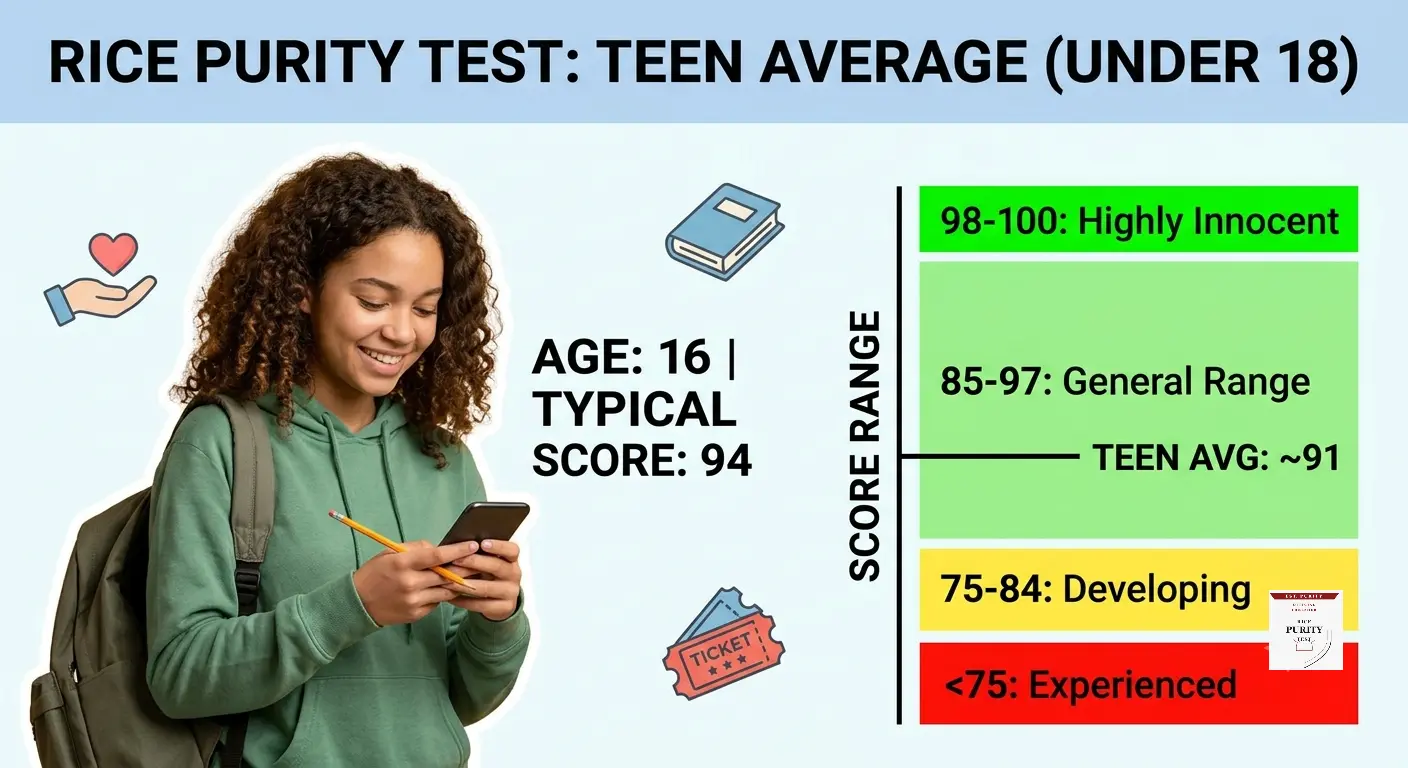
| Under 18 | ~91 | Very few listed experiences; expected |
| 18–24 | ~85 | College years beginning; scores start dropping |
| 25–34 | ~75–76 | Broader experience; significant drop from early 20s |
| 35 and over | ~64 | Closer to the all-ages global mean |
| All ages | ~63–64 | The number most sites quote — misleading without age context |
Scores drop fastest between 16 and 22, with the steepest decline in the first two years of university typically 15–20 points during that window alone, based on survey-based estimates across multiple self-reported datasets.
A 19-year-old scoring 82 is above average for their age group. That same score on a 32-year-old is notably high. Same number, completely different meaning.
What Is a Good Rice Purity Test Score?
Genuinely, there isn’t one. The test assigns no value in either direction it’s a headcount of yes answers, not a moral ranking.
That said, two camps have built competing interpretations online. One treats low scores as proof of a full, uninhibited life. The other frames high scores as signs of discipline, faith, or personal restraint. Both are projecting meaning onto a number that was designed to start conversations at college orientation, not measure anyone’s character.
If your score is above average for your age group, you’ve had fewer of the listed experiences than your peers. If it’s below average, you’ve had more. Neither is better. They’re just different snapshots of different lives.
Is a Score of 100 Rare? What About 0?
Both extremes are genuinely uncommon but one is far rarer than the other.
The Rice Thresher’s dataset found 2,719 perfect scores of 100 across 124,952 takers. That’s about 2.2% of respondents not vanishingly rare, but unusual for adults. Most perfect 100s come from younger teenagers taking the test early.
Perfect zeros, by contrast, appeared only 336 times in the same dataset less than 0.3% of takers. Given that a zero requires saying yes to all 100 questions (including items most people will never encounter regardless of lifestyle), scores that low are almost certainly influenced by exaggeration in at least some cases.
Both extremes are statistical outliers. If you landed near either end, you’re firmly outside the norm though what that actually says about you is another question entirely.
Problems With the Rice Purity Test
Equal weighting makes no sense.
One point off for holding hands. One point off for a felony. The bluntness of the system misses everything about how experiences actually differ in weight and context.
Binary questions flatten complex reality.
“Have you used illegal drugs?” covers one edible at a licensed dispensary and a decade of serious addiction with identical scoring. The format is too crude to mean much at the individual level.
“Purity” is doing unearned moral work.
The framing makes low scores feel like confessions and high scores feel like virtues. That’s a product of when the test was written the 1980s not an accurate reflection of how most people now think about experience and character.
Self-reported data is inherently noisy.
Some people underreport out of embarrassment. Others overreport because a low score makes them seem interesting. Every published average is a survey-based estimate drawn from self-reported datasets treat them as rough benchmarks, not hard facts.
FAQ — Questions People Are Actually Searching
Is 70 a good Rice Purity score?
It depends on your age. At 17, a 70 is below the under-18 average of ~91 meaning you’ve had more listed experiences than most your age. At 25, a 70 is actually above the 25–34 average of ~75. The same score reads differently depending on where you are in life. Compare to your age group, not the all-ages figure.
What is the average Rice Purity score at 18?
Around 85, based on widely-cited self-reported aggregates. The 18–24 bracket averages approximately 85.26. If you’re 18 and scored anywhere from the high 70s to the low 90s, you’re in a completely typical range. Expect that number to drop by 15–20 points before you’re 22.
What does a score of 100 mean on the Rice Purity Test?
You answered no to all 100 questions. It means none of the listed experiences apply to you or at least none you’re willing to report. About 2.2% of documented takers scored a perfect 100, mostly younger teenagers. For adults, it’s genuinely rare.
Does the Rice Purity Test actually mean anything?
As a conversation starter, yes. As a measure of character, intelligence, relationship potential, or maturity no. Zero scientific validity. The creators themselves say it shouldn’t be taken seriously. What it does capture, imperfectly, is a rough count of certain life experiences relative to your peer group. That’s it.
Why do I feel weird about my score?
Because the word “purity” carries moral weight the test doesn’t actually assign. Whether your score feels too high (am I boring?) or too low (should I be embarrassed?), that discomfort is yours it’s not coming from the number itself.
Can your Rice Purity score go back up?
No. Scores only move in one direction. You can’t un-have an experience. If you retake the test honestly, your score will either stay the same or decrease never increase.