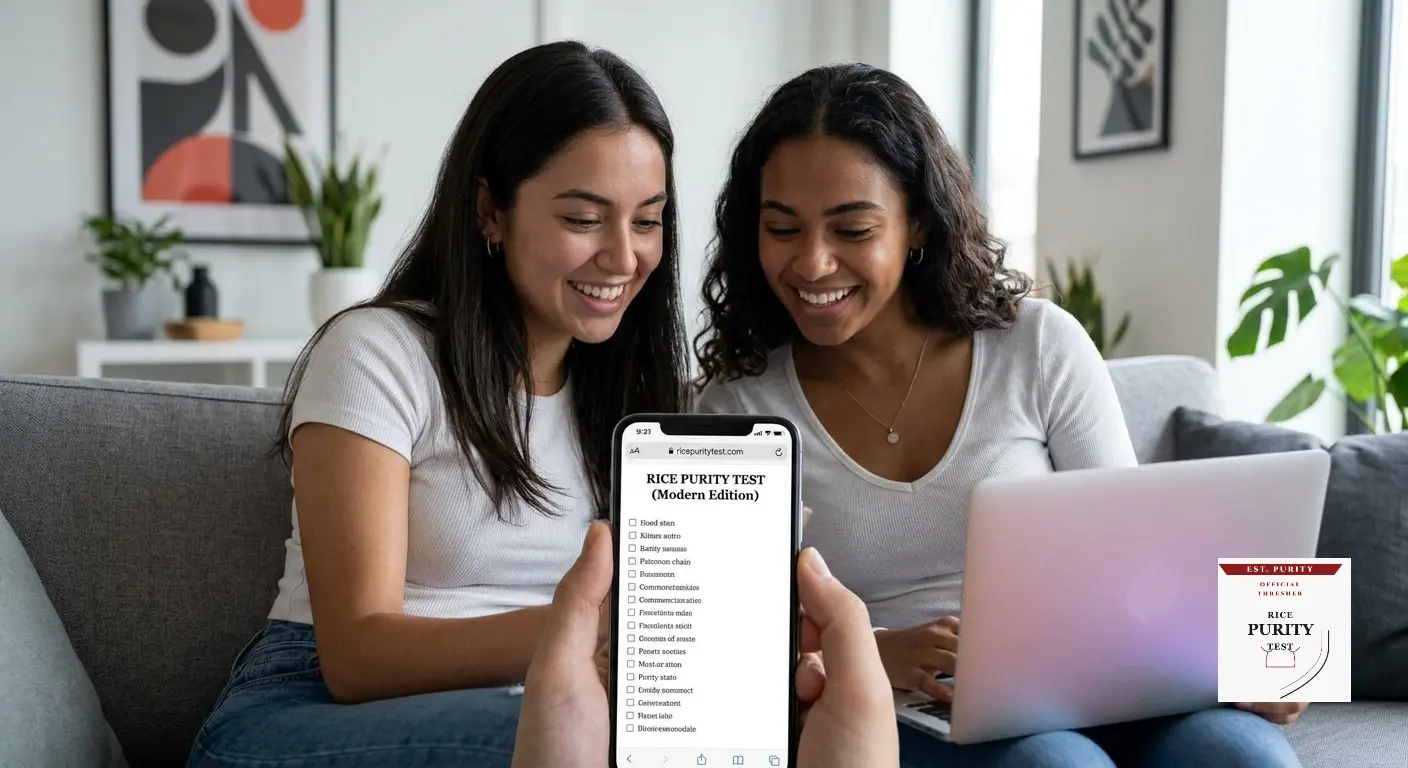
The Rice Purity Test originated at Rice University in the early 1980s as a freshman orientation tradition. One hundred yes/no questions. One number between 0 and 100. Simple enough to survive decades — flexible enough to get cloned into a dozen different flavors.
This guide compares the most widely shared Rice Purity Test variants currently circulating across online communities and social platforms.
Over the years, dozens of Rice Purity Test variants have appeared online. Some are designed for teens, gaming communities, religious groups, fandoms, and cultural identities, while others completely reinvent the original format. These different Rice Purity Tests reflect how internet communities personalize trends to match their own experiences and humor.
Some variants are meaningfully different — they swap out the entire question set to fit a specific community. Others are just the standard test with a new name slapped on for search traffic. This guide covers the ones that actually matter, what sets each apart, and who they’re genuinely built for.
The 10 Types of Rice Purity Tests
1. Original 100-Question Rice Purity Test
This is the one everything else branches from — the original Rice Purity Test that all other versions are measured against. Six categories cover the full range of young adult experience:
– Romance & Dating: Holding hands, first dates, relationships
– Physical/Sexual: Intimacy milestones, explicit behavior
– Substances: Alcohol, tobacco, drugs
– Legal & Academic: Cheating, trespassing, law enforcement
– Dishonesty: Lying and deception
– Miscellaneous: Catch-all experiences that don’t fit elsewhere
Questions progress deliberately from mild to specific. Early ones feel almost universal — holding hands, telling a white lie. By question 80 or so, the territory gets considerably more niche. That gradient is what keeps completion rates above 85%. People are curious enough about what comes next that they finish all 100.
Best for: College orientations, new friend groups, and general self-reflection. Still the benchmark every other rice purity test variant is measured against.
2. Rice Purity Test for Teens
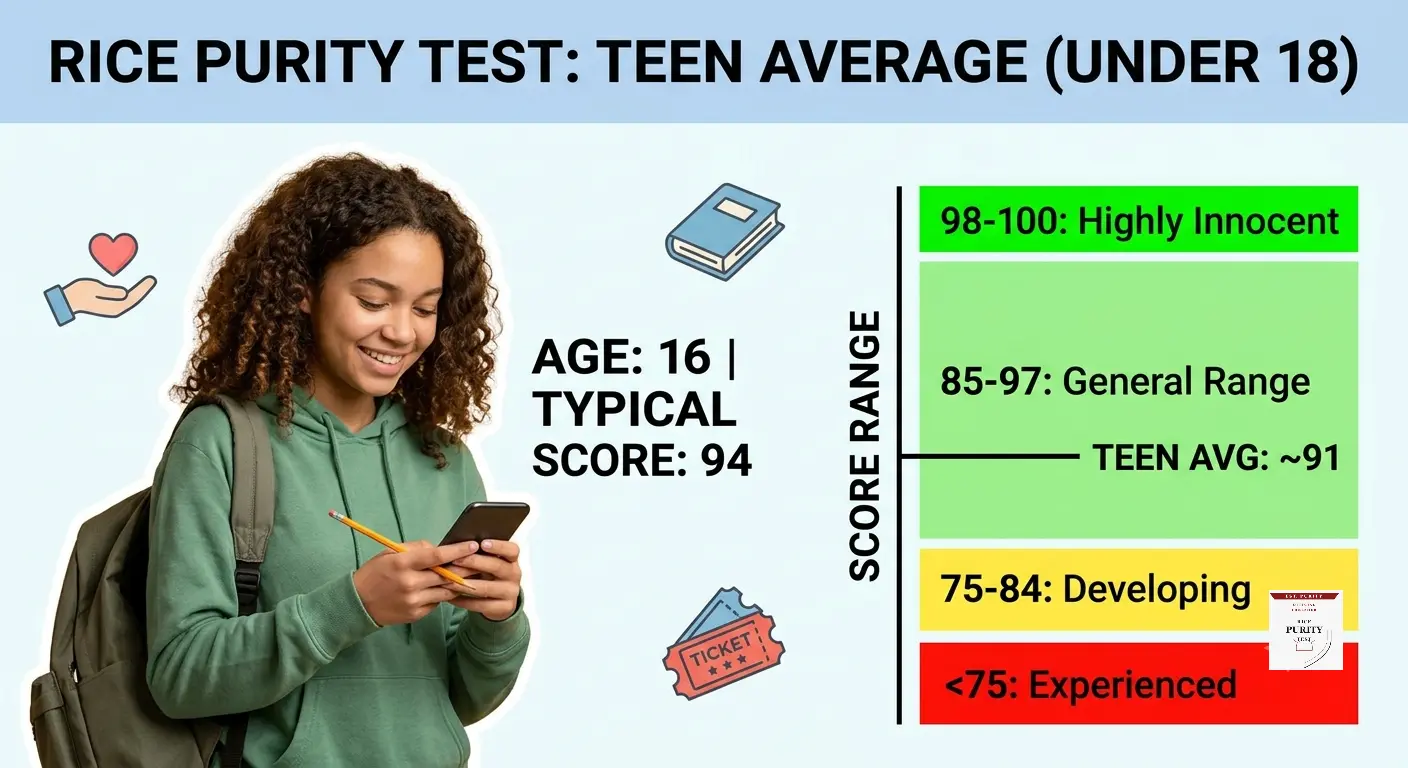
The most searched variant after the original, and the most important to get right. A proper teen Rice Purity Test replaces adult content with milestones that actually map to a 13–17 year old’s life:
– Sneaking out past curfew
– Copying homework or cheating on a test
– First crushes and awkward texts
– Lying to parents about where you’re going
– Peer pressure situations at school
– Breaking rules at home (not laws)
The problem? Not all tests labeled “teen” have been genuinely edited. Some publishers just add “teen” to the title for search clicks while leaving adult content fully intact.
How to spot a fake teen version:
Red flags to avoid:
– Still includes explicit sexual behavior questions
– Drug questions describe specific highs in detail
– Questions require adult context to even understand
Green flags that signal a safe version:
– Relationships stop at kissing
– Substance questions are mild or absent entirely
– Every question makes sense to a 14-year-old
Always scan the question list yourself before sharing with anyone under 18. This is one of the most popular TikTok purity test trends precisely because younger audiences are actively searching for age-appropriate versions.
3. Sex Rice Purity Test
The standard test dedicates roughly 20–30 questions to physical and sexual experience. This variant flips that proportion entirely — expanding the sexual category to 50–70 questions while compressing or removing everything else.
What changes compared to the original:
– Substance, legal, and academic questions are mostly removed
– Sexual experience questions are dramatically expanded
– Orientation and relationship diversity is included in better versions
What stays the same:
– 100-question format (in most versions)
– Yes/No answer structure
– Single score output
The score here measures a specific slice of life, not overall experience. Comparing it to a standard test score doesn’t work — the domains are too different for the numbers to mean the same thing. Quality varies a lot. Better versions are non-judgmental and inclusive. Others lean into shock value for clicks. Worth previewing before sharing.
For adults only. No exceptions.
4. Mormon Rice Purity Test
One of the most substantively different rice purity test versions — not just cosmetically altered. LDS (Latter-day Saint) communities follow a specific behavioral framework that overlaps with the standard test in some places and diverges sharply in others.
The standard test asks about alcohol, tobacco, and illegal drugs. The Mormon version goes further and also asks about:
– Coffee and tea (prohibited under the Word of Wisdom)
– Caffeinated sodas
– Premarital physical intimacy (significantly expanded section)
– Temple attendance and faith commitments
– Mission service history
– Community and family obligations
For someone inside the LDS community, the standard test misses half their actual life. This version maps onto their real behavioral landscape. It’s one of the rare rice purity test variants that adds entirely new question categories rather than just editing existing ones.
Circulates primarily within LDS youth groups and online faith communities.
5. Mexican Rice Purity Test
Built around the shared cultural experiences of Mexican and Latin American communities — especially people navigating that dual-identity space between Mexican family culture and wherever they actually grew up.
Sample questions that typically appear in these versions:
– Attended a quinceañera
– Been hit with a chancla
– Had your mom call every 20 minutes
– Been compared unfavorably to a cousin
– Eaten tamales at literally every family event
– Had your location tracked by a parent past age 20
– Felt Mexican around Americans and American around Mexicans
The humor comes from inside the culture. The chancla joke doesn’t punch down — it’s a shared touchstone that lands because everyone taking the test already knows exactly what it means. Standard experiences like sneaking out and first drinks show up too, but framed through a Mexican household lens.
Circulates heavily on TikTok and in Mexican-American friend groups. One of the most creatively executed cultural rice purity test variants out there.
6. VRChat Rice Purity Test
Probably the most alien of all the different rice purity tests to anyone outside the community. VRChat is a social VR platform with its own subcultures, norms, and relationship structures — and this test measures experience within that specific ecosystem, not the physical world.
Items from a typical VRChat rice purity test include:
– Done ERP (erotic roleplay) in a virtual world
– Slept with your headset still on
– Spent 8+ continuous hours in VR
– Joined a VRChat “cult” or close-knit group
– Had your first parasocial VR crush
– Been banned from a public world
– Cycled through 3+ avatar identities in one session
– Cried while in VR
None of this maps to physical-world experience — which is the entire point. Virtual social life has its own milestones now, and this test treats them seriously. Scores from this version cannot be meaningfully compared to any other rice purity test format.
Fascinating as a cultural document even if you’ve never put on a headset.
7. Mental Rice Purity Test
The format shift here is fundamental. Instead of asking what you’ve done, it asks what you’ve felt. This version maps emotional and psychological experience instead of behavioral history — making it one of the most structurally unique of all rice purity test versions.
Where the standard test asks “Have you drunk to excess?” — the mental version asks “Have you gone three days without leaving your house?”
Where the standard asks “Have you used illegal drugs?” — the mental version asks “Have you dissociated mid-conversation?”
Where the standard asks “Have you been arrested?” — the mental version asks “Have you wanted therapy but haven’t gone?”
The better implementations acknowledge an obvious tension: in the standard test, more boxes checked means a lower score. But struggling with anxiety or depression isn’t a moral failing — it might mean you’ve examined yourself honestly, or simply had a harder time than most. The best mental rice purity test versions function less as scoring tools and more as reflection prompts.
Not a clinical tool and not a diagnostic. Works best as a gentle online self-assessment quiz and check-in — a way to name things you might not have put words to before.
8. Celebrities Rice Purity Test
Two formats exist here, and they’re pretty different in spirit.
Format A — Aspirational (you take it as a celebrity):
Asks whether you have had celebrity-scale experiences like appearing on a red carpet, being interviewed on live TV, having a bodyguard, trending on social media, or giving a public apology statement. Silly, harmless, and fun.
Format B — Celebrity-scoring (apply it to someone famous):
Uses the standard checklist against a specific celebrity based on public knowledge — producing a score for them. More complicated territory. It mixes verified facts with speculation and evaluates someone’s purity without their consent.
The format makes celebrity gossip feel structured and shareable — which is why it spreads well as a viral online quiz despite the ethical messiness of Format B.
Format A is a fun party game with no real issues. Format B is worth approaching with some common sense.
9. True Asian Rice Purity Test
Designed around the experience of East Asian diaspora — people raised with East Asian family structures regardless of which country they actually grew up in. The test name winks at the stereotype; the questions earn their specificity.
On top of the standard question categories (romance, substances, legal, academic), the True Asian Rice Purity Test adds:
– Academic pressure as familial obligation (“Got a B+ and felt like you failed”)
– Parental comparison dynamics (“Been compared to a sibling academically”)
– Filial piety experiences (“Put family obligation ahead of personal plans”)
– Cultural expectation pressure (“Had your creative career dismissed as impractical”)
– Immigrant parent dynamics (“Translated documents for your parents”)
The most emotionally layered of all the cultural rice purity test variants. It captures experiences mainstream culture rarely reflects back to this community — academic perfectionism, intergenerational expectation, dual-identity navigation.
Circulates widely in Asian-American, Asian-British, and Asian-Australian communities.
10. Big Mouth Rice Purity Test List
Netflix’s Big Mouth follows middle schoolers navigating puberty with anthropomorphic hormone monsters. The show’s devoted fanbase built a fandom purity test list around its specific scenarios — fan-made, unlicensed, and widely shared anyway.
Questions pull directly from the show’s themes:
– The awkward puberty confusion the characters live in
– Middle school social hierarchies and betrayals
– Early relationship feelings in an age-appropriate context
– Parent relationships and the mortification they cause
– The specific cringe humor the series has built its whole brand on
This one works as a fandom purity test more than a genuine self-assessment. If you’ve watched Big Mouth and check 40 of 70 items, you’re mostly confirming that the show resonated with you — which is the actual point. Less “how pure are you,” more “how much did you see yourself in this.”
Best experienced as fan engagement content, not a standalone self-reflection tool.
Quick Comparison
Variant | Primary Audience | Core Focus | Best Use Case
Original (100Q) | College / Adults | Broad life domains | General bonding
Teen Version | Under 18 | Age-appropriate milestones | Safe peer quiz
Sex Version | Adults only | Sexual experience | Adult reflection
Mormon Version | LDS community | Faith-based norms | Religious groups
Mexican Version | Latin diaspora | Cultural family experiences | Identity humor
VRChat Version | VR users | Virtual social life | VR communities
Mental Version | Wellness-focused | Emotional & psychological | Self check-in
Celebrities Version | Pop culture fans | Fame experiences | Entertainment
True Asian Version | East Asian diaspora | Academic & cultural pressure | Diaspora groups
Big Mouth List | Show fans | Fan engagement | Fandom fun
Which Rice Purity Test Should You Take?
Not sure which of these different rice purity tests fits you? Here’s a quick breakdown:
– Original Test: Best for general friend groups and first-time users
– Teen Version: Best for under-18 audiences needing a safe format
– VRChat Version: Best for online gaming and VR communities
– Mental Version: Best for emotional self-reflection and self-awareness
– Sex Version: Best for adult audiences exploring that specific lens
– Mormon Version: Best for LDS communities and faith-based friend groups
– Mexican Version: Best for Latin cultural identity humor and recognition
– True Asian Version: Best for East Asian diaspora shared experience
– Celebrities Version: Best for pop culture fans and aspirational entertainment
– Big Mouth List: Best for fandom engagement with the Netflix show
FAQ About Rice Purity Test Variants
How many types of rice purity tests are there?
At least 10 well-known, substantively different variants. Dozens more exist as minor rebrands of the standard test with nothing actually changed in the question set.
Which rice purity test is safe for someone under 18?
A genuinely edited teen version — not just a renamed standard test. Scan the question list yourself first. Real adaptations remove explicit sexual and substance content entirely.
Which type is most different from the original rice purity test?
The VRChat version — it doesn’t share a single question category with the original. The mental health version is also genuinely different, shifting from behavioral to psychological experience.
Can you compare scores across different rice purity test versions?
Not meaningfully. A 40 on the VRChat test and a 40 on the standard test describe completely different things. Each version’s score only makes sense within that specific version.
Is the mental rice purity test a real psychological assessment?
No. None of these are clinical tools. The mental version works as a reflection prompt, not a diagnosis. If you’re genuinely struggling with mental health, speaking with a professional is the right step.
Where did the original rice purity test come from?
It originated at Rice University in the early 1980s as a freshman orientation tradition.
Final Thoughts
The Rice Purity Test has survived for decades because the format is simple, social, and endlessly adaptable. What began as a college orientation activity eventually evolved into dozens of internet-driven variations built around different cultures, fandoms, age groups, and online communities.
The best Rice Purity Test version is always the one that reflects your own experiences, humor, and environment — not somebody else’s.
Disclaimer: For entertainment and self-reflection only. Not a clinical assessment. Intended for users 18+ unless using an age-adapted version. Updated November 2025.